NextGen
SmartKids
MoneyLab Life Skills
All MoneyLab paths
AGES 13–18 · FICTIONAL CAD

MoneyLab Life Skills

Practise work, credit, saving, contracts and independent-life decisions.

10 levels1 lessonsPractice · Explain · Reflect
LEVEL 1 · LESSON 1

Values, choices and opportunity cost

Noor has $120 of fictional gift money. A concert ticket costs $90; a course materials fund needs $80. Noor can choose either now, but not both. The decision should reflect Noor’s priorities rather than a friend’s spending.

Learning goals

Learning goals

  • Identify the opportunity cost of a money choice
  • Compare a choice with a stated priority

What success looks like

  • I can identify the opportunity cost of a money choice.
  • I can compare a choice with a stated priority.
NEXTGEN SMARTKIDS · WATCH & TRY

Learn with Lumi’s whiteboard.

7 visual chapters · English narration · Pause and practise

MoneyLab Life Skills01 / 7
YOUR MONEY STORY

Two goals, one balance

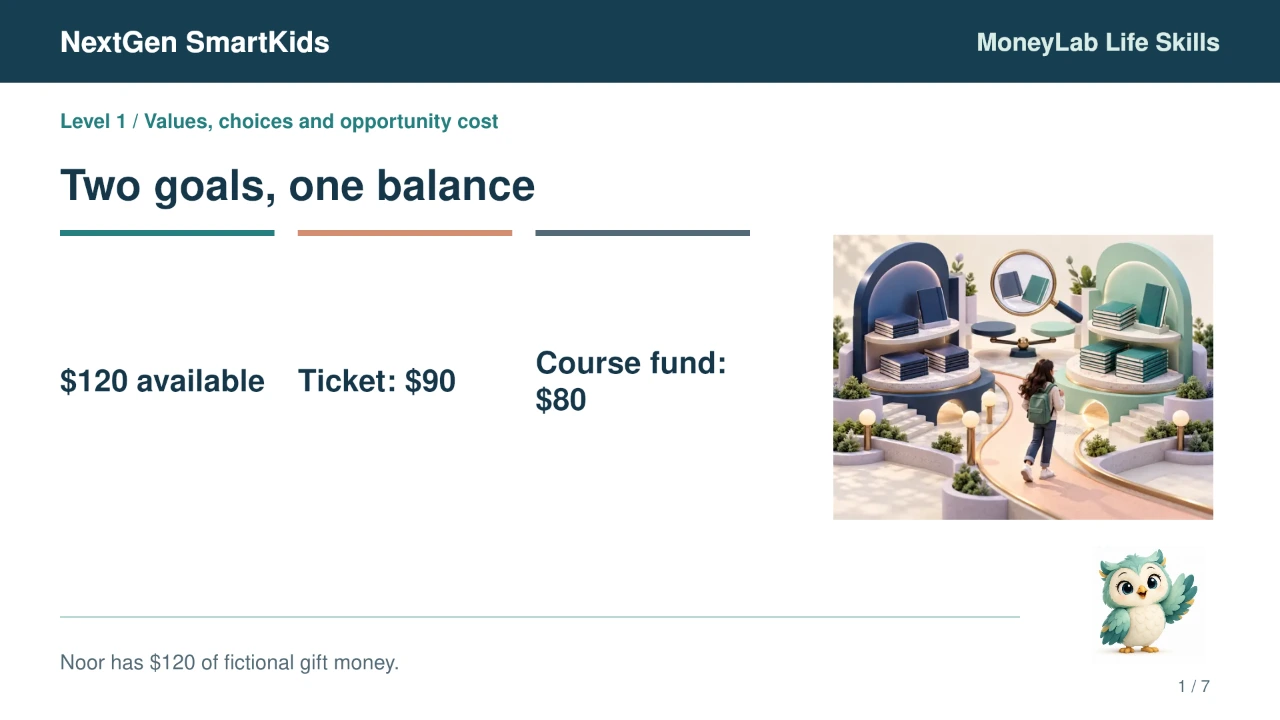
Two goals, one balance — $120 available; Ticket: $90; Course fund: $80
$120 availableTicket: $90Course fund: $80

Pause to predict. Explain what changes. Try the activity.

0:00 / 3:30
Read the full narration

1. Two goals, one balance

Noor has $120 of fictional gift money. A concert ticket costs $90; a course materials fund needs $80. Noor can choose either now, but not both. The decision should reflect Noor’s priorities rather than a friend’s spending. Today, we will identify the opportunity cost of a money choice. Compare a choice with a stated priority.

2. The next best alternative

An opportunity cost is the next best alternative you give up when you choose. It is not every possible thing you could have bought. State the two feasible choices, then explain what becomes unavailable after selecting one.

3. Follow the remaining money

Let us work through a teaching example. Start with $120; buying the $90 ticket leaves $30. The $80 materials fund cannot then be fully funded; its shortfall is $50. Choosing the $80 fund instead leaves $40, below the ticket price. Neither option funds both goals today. Noor must prioritise, save longer or find an affordable alternative.

4. Make the priority visible

Values help explain priorities, but people with different circumstances may make different reasonable choices. Compare price, usefulness and timing rather than labelling all enjoyable purchases as bad. A choice can meet a want and still belong in an affordable plan.

5. Question the cheapest-is-best rule

A short pause can make a pressured choice clearer. Record what you want to achieve, what you can afford and what evidence would change the decision. The aim is a reasoned explanation, not guessing which preference an adult will approve. The cheapest option is not automatically the best; the next best alternative depends on Noor’s actual priority.

6. Eli’s new decision

New case: Eli has $150 and prioritises a $100 course kit over an $85 event. Eli buys the kit with no other costs. Calculate the remaining money and name the opportunity cost. Subtract the chosen kit price from the available money. Choose the best forgone alternative from the stated options.

7. Explain a changed priority

Explain what would change if the event were Eli’s higher priority. What evidence would make you change the choice? Demonstrate understanding by explaining your calculation, using the evidence in the case, and describing when your decision would need to change.

Read the explanation & worked example

Understand the idea

An opportunity cost is the next best alternative you give up when you choose. It is not every possible thing you could have bought. State the two feasible choices, then explain what becomes unavailable after selecting one.

Values help explain priorities, but people with different circumstances may make different reasonable choices. Compare price, usefulness and timing rather than labelling all enjoyable purchases as bad. A choice can meet a want and still belong in an affordable plan.

A short pause can make a pressured choice clearer. Record what you want to achieve, what you can afford and what evidence would change the decision. The aim is a reasoned explanation, not guessing which preference an adult will approve.

Worked teaching example

  1. Start with $120; buying the $90 ticket leaves $30.
  2. The $80 materials fund cannot then be fully funded; its shortfall is $50.
  3. Choosing the $80 fund instead leaves $40, below the ticket price.
Neither option funds both goals today. Noor must prioritise, save longer or find an affordable alternative.

Build and revise a fictional money plan

Use a pretend amount for your scenario. Separate commitments, choices and saving before deciding how much room remains.

Total allocated$80.00
Room remaining$20.00

This plan fits the available funds. Imagine a surprise cost. Which choice would you change, and why?

Values, choices and opportunity cost mission

New case: Eli has $150 and prioritises a $100 course kit over an $85 event. Eli buys the kit with no other costs. Calculate the remaining money and name the opportunity cost.

Check your thinking

1. If Noor buys the $90 ticket from $120, what remains?
2. What best describes opportunity cost?
3. Two learners choose differently with the same prices. What should be evaluated?

Sign in with the selected learner's account to save evidence. This view is a preview or review.

Reflect and try it away from the screen

What evidence would make you change the choice?

Use two fictional decision cards; explain a choice verbally, then exchange the priority and reconsider.

Sources & curriculum connections

Making a budget · checked 2026-10-14
Budget categories, income and expenses; original fictional scenarios.

Original supplementary learning. Provincial curriculum coverage and independent educator validation are documented separately.